The decision to replace the mud fort with something permanent
was driven not by conditions at the Cape, but by events
happening seven thousand kilometres away in Europe.
A Strategic Chokepoint
War in Europe, walls in Cape Town
By 1664, England and the Netherlands were sliding towards
war. Suddenly the Cape wasn’t just a vegetable stop
- it was a strategic chokepoint. Whoever controlled it
controlled the sea lane to Asia. If Britain took it, the
VOC’s entire empire would be cut off from its source of
wealth.
The VOC sent out a commissioner
(Isbrand Goske) and a
master builder
(Pieter Dombaer) with a clear brief: design
and build something that can actually survive a modern naval
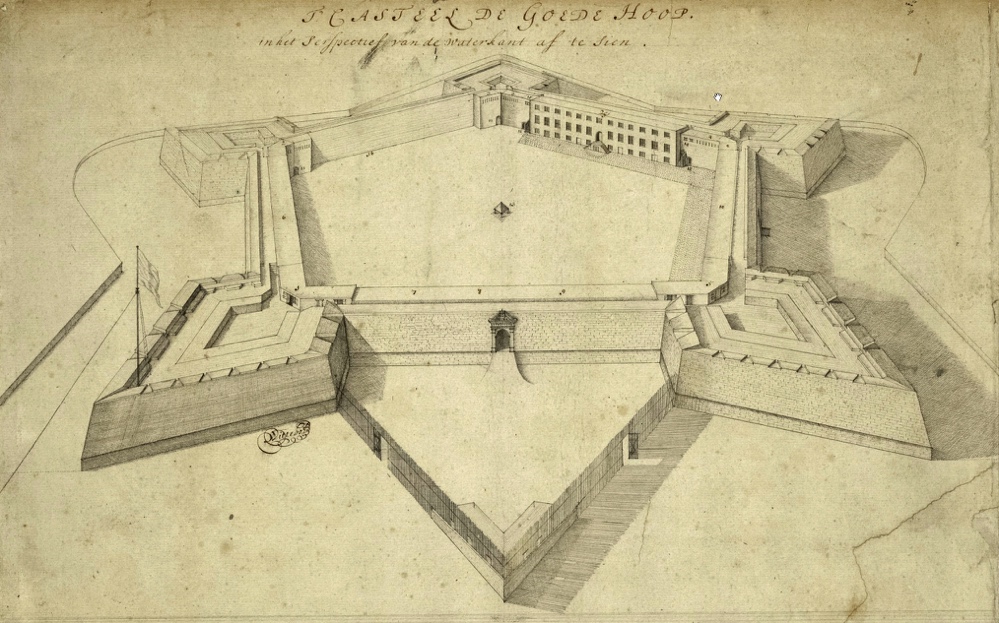
attack. They arrived with an architectural concept called a
trace italienne
- an Italian-style pentagonal bastion fort. This
design had been revolutionising European military
engineering for nearly a century already.
Kasteel de Goede Hoop - a 17th-century drawing of the pentagonal star fort
Why a Pentagon?
The military geometry of the bastion fort
Medieval castles had tall, thin walls and round towers. They
looked impressive, but the advent of cannon fire exposed a
fatal flaw. One well-aimed shot could punch straight through
a wall that had taken years to build.
Military engineers, mostly in Renaissance Italy, came up with
a fix. Instead of building high, they built low and thick.
The walls were so wide and heavy that cannonballs would
simply bury themselves in the earth rather than breaking
through. And instead of the usual square or rectangular
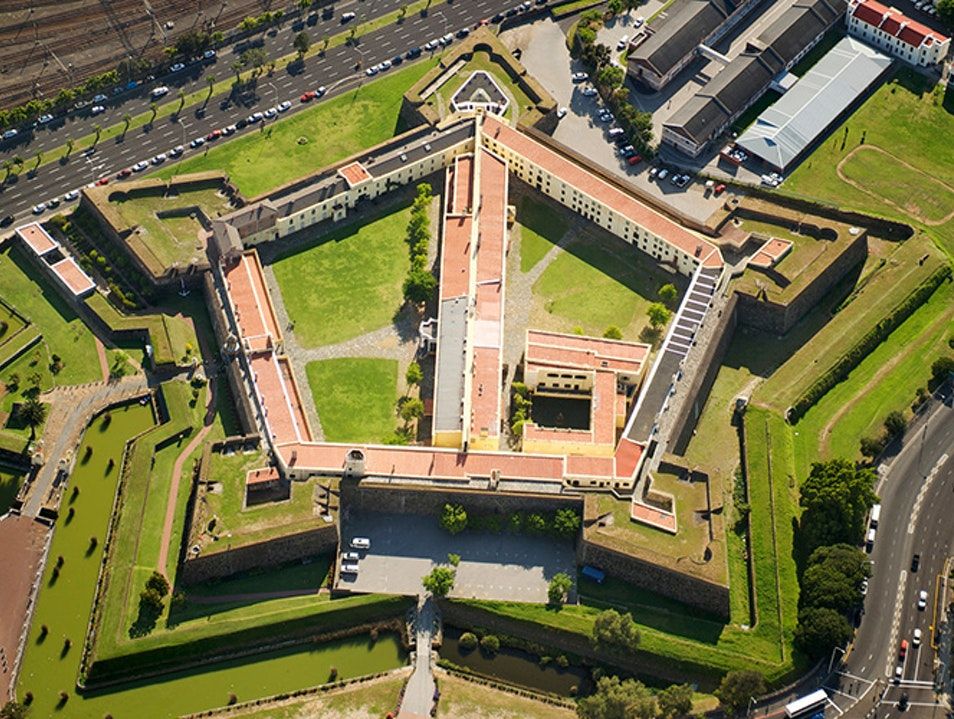
shape, they arranged the walls in a five-pointed star, with
triangular points - called bastions
- jutting outward at each corner.
The clever part is the geometry. Each bastion can fire along
the wall next to it, which means there is nowhere an
attacker can stand that is not being shot at from at least
two directions at once. Try to storm one section of wall and
you are getting hit from the front and from the sides
simultaneously.
For its time, if you had enough soldiers inside, it was
basically impossible to take by force.
Separate Gunpowder Magazines
Seventeenth-century compartmentalisation
Each bastion contained its own
independent gunpowder stores. This was a
deliberate and clever piece of military engineering.
If one exploded - hit by enemy fire, or simply
catching a spark - the others would survive intact.
The Castle could lose one point of the star and still fight.
It was seventeenth-century
compartmentalisation, and it was brilliant.
This is the same logic that underlies modern ship design,
where watertight bulkheads prevent a single hull breach from
sinking the entire vessel.
Thirteen Years to Completion
Nothing about this building was built to be temporary
The foundation stone was laid on
2 January 1666.
It took thirteen years and between
200 and 300 workers at any given time to
complete. The walls rose to ten metres high
and three metres thick. The
foundations went
three and a half metres into the ground.
Nothing about this building was built to be temporary. It
was officially completed on
26 April 1679 and it is still standing
today.
The same star - preserved across three and a half centuries