One of the most striking facts about the Castle of Good Hope
is that despite being purpose-built as a military fortress,
it has never once been captured by direct attack.
Every time it changed hands, the actual fighting happened
elsewhere. The Castle simply surrendered when the outcome was
decided.
Its walls, in a sense, were always good enough that no one
ever tested them properly.
What the Castle could not do was control who won the wars
happening in Europe. Its fate was always decided far away, by
people who had never seen Table Bay.
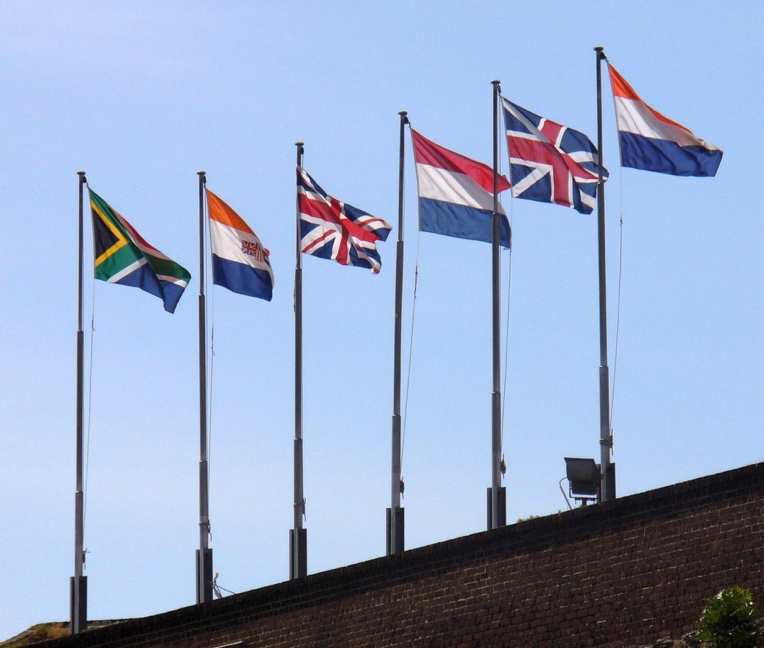
Six flags, three centuries - flying together over the Castle today1
The Dutch East India Company (VOC)
1652 – 1795 · 143 years
For 143 years, the Castle was the nerve centre of the Cape
Colony - part logistics hub, part government, part military
base, part prison and courthouse. It was the place where
everything that mattered was decided. The colony that had
started as a vegetable garden grew into something far more
complex and far more troubled, fuelled by enslaved labour
and the steady dispossession of the Khoekhoe people.
In 1682, Governor Simon van der Stel moved the main entrance
from the seaward side to the landward side. Cape storms kept
flooding the courtyard through the original gate. A
practical fix. But it is also a neat metaphor for the whole
VOC era: constantly adapting to a reality that never matched
what the directors in Amsterdam had imagined.
The VOC flag - flown from 1652 to 1795
Human Story: Governor Van Noodt and the Curse (1729)
A curse from the gallows
Governor Pieter van Noodt sentenced seven soldiers to death
for desertion. One of the condemned men cursed him from the
gallows, calling divine judgement down on his head. Van
Noodt dismissed it. That same evening, servants found him
dead in his chair - mid-conversation, no warning, no clear
cause.
The castle records confirm his death. The cause was never
established. His ghost, according to local legend, still
walks the battlements.
2
The First British Occupation
1795 – 1803 · 8 years
The first British takeover of the Castle had nothing to do
with the Cape and everything to do with France.
In 1795, French Revolutionary forces swept through the
Netherlands and established the Batavian Republic -
effectively a French puppet state.
Britain, already at war with France, immediately worried
about French access to the Cape. A French-controlled Cape
would threaten British shipping to India.
British forces landed at Muizenberg, a
coastal village south-east of Cape Town, in
July 1795. The Dutch defenders made a
stand, but they were outgunned and poorly supplied. After a
brief but decisive engagement, the Dutch retreated.
The Castle, some distance away, assessed the situation and
surrendered without a shot being fired at its walls. For the
second time in the Castle’s history - and it would not
be the last - the fortress changed hands not because of any
failure of its own defences, but because the battle that
mattered had already been lost somewhere else.
A new flag went up. British uniforms replaced Dutch ones.
English replaced Dutch as the language of official
correspondence. But essentially the machinery of colonial
government carried on as before.
At this point in time, the British had not come to transform
the Cape - they had come to deny it to France. For eight
years, that was enough.
The Union Jack - flown from 1795 to 18033
The Batavian Republic
1803 – 1806 · 3 years
The Treaty of Amiens paused the European
wars in 1802. As part of the peace settlement Britain agreed
to hand the Cape back to the Dutch - now reconstituted as
the French-backed Batavian Republic.
New officials arrived. The flag changed.
Three years later, the peace collapsed and the whole process
reversed again.
The people actually living at the Cape had no vote in any
of this. Their home was traded back and forth between
European powers like a commodity, decided by people who had
never been to Africa.
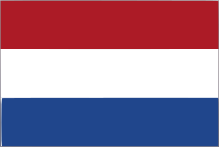
The Batavian Republic flag - flown from 1803 to 1806
Human Story: Governor Janssens on Horseback
A governor who wouldn’t stay behind a desk
Governor Janssens was not a desk man. He regularly rode out
from the Castle unannounced to inspect farms and
settlements. This was unusual behaviour for a governor and
surprised a population accustomed to governors who remained
firmly within the Castle’s walls. He reportedly had a
keen interest in the geography and natural history of the
Cape, and his journals from this period describe the
landscape with enthusiasm and excitement.
When the British returned in 1806, he led the Dutch defence
at the Battle of Blaauwberg in person, on horseback,
fighting long after the outcome was clear. He then rode back
to the Castle to arrange its surrender. Even in defeat, he
was in the field.
4
The Second British Occupation
1806 – 1910 · 104 years
The Napoleonic Wars killed the peace. Britain landed 6,700
troops at Bloubergstrand in
January 1806. The
Battle of Blaauwberg lasted only a few
hours. The Castle changed hands again, for the fourth time,
without a shot being fired at its walls.
In 1814, the
London Convention made it official: Britain
bought the Cape Colony from the Dutch for
six million pounds, treating an entire
continent’s worth of people as an accounting entry.
By 1811, the colonial government had expanded sufficiently
that it needed purpose-built administrative buildings, they
moved out of the Castle and the Castle was handed over
entirely to the military. It became a garrison, a prison,
and a storage facility. It was during this period that the
Castle acquired its darkest reputation as a place of
detention, not for ordinary criminals, but for significant
political and military opponents of British Empire and its
colonial expansion.
The pattern that emerged in the Castle’s dungeons
during this century is worth pausing over.
Three African kings:
Cetshwayo of the Zulu
Langalibalele of the Hlubi
Sekhukhune of the Pedi
were each imprisoned here after fighting to defend their
people against colonial encroachment. They came from
different nations, fought different wars, in different
decades. But they ended up in the same building, behind the
same walls.
The Castle, in this era, was where the British Empire put
the men who had most effectively resisted it.
One on my ancestors was imprisoned in the Donker Gat too.
Interestingly, he was on my Dad’s side of the family,
and was imprisoned for murdering people on my Mom’s
ancestral lineage!
The Union Jack - flown from 1806 to 1910
Human Story: Fritz Joubert Duquesne and the Iron Spoon
An iron spoon and a tunnel that almost worked
During the Anglo-Boer War (1899–1902), the Castle held
Boer prisoners and political detainees. Among the most
colourful was Fritz Joubert Duquesne, a Boer officer of
French Huguenot descent with a personality considerably
larger than his prison cell.
Unable to accept captivity, Duquesne obtained an iron spoon
and began, with extraordinary patience and determination, to
scrape away at the mortar and cement of his cell wall. Over
a period of months, he made slow but definite progress -
enough to be optimistic about escape. He nearly made it
until a falling stone trapped him in his own tunnel! He was
dug out, his escape route sealed, and his spoon
confiscated. He later escaped by other means and went on to
become an international spy and adventurer of considerable
notoriety. He claimed that the spoon had been the most
dangerous weapon he ever carried.
The story has the air of legend, but the historical record
confirms both his imprisonment and his escape attempts.
5
The Union and Republic of South Africa
1910 – 1994 · 84 years
In 1910, South Africa became a
self-governing state within the British
Empire. The four colonies of southern Africa - the Cape
Colony, Natal, the Transvaal, and the Orange River Colony -
were merged into the Union of South Africa.
The Castle, which had been a British military base for over
a century, transferred to the authority of the new South
African state. It became the headquarters of the South
African Army’s Western Cape command, a function it
would retain for the next eight decades.
In 1936, the Castle was declared a
National Monument - a formal recognition
of its historical importance that, in theory, protected it
from demolition or insensitive alteration. The walls that
had been built to defend a Dutch trading empire were now
being preserved as a heritage asset by the country that had
grown up inside and around them.
In 1948, the
National Party came to power and introduced
apartheid - a system of legislated racial
segregation that classified every person in South Africa by
race, determined where they could live, work, and go to
school, and enforced those determinations through state
violence.
The Castle, as the headquarters of the army that gave
apartheid its military backbone, was deeply implicated in
this system. The same yellow walls that had once held
African kings now housed the command structure of an army
used to suppress the people those kings had once led.
This is the most uncomfortable section of the Castle’s
history to sit with. The building itself did not change.
The flag did. The building continued doing what it had
always done: serving whoever held power.
The Union / apartheid-era flag - flown from 1910 to 1994
Human Story: King Cetshwayo - Dignity in Defeat
The king who embarrassed an empire
King Cetshwayo of the Zulu had humiliated the British Empire
at the Battle of Isandlwana in January 1879 - the worst
military defeat the British Army had suffered at the hands
of an indigenous force in the entire Victorian era. Over a
thousand British soldiers died in a single afternoon.
The British regrouped, returned with reinforcements, and
defeated the Zulu at the Battle of Ulundi six months later.
Cetshwayo was captured, brought to Cape Town, and held in
the Castle. By all accounts, he bore his captivity with
remarkable dignity. He was visited by curious Capetonians
who came to see the man who had embarrassed an empire, and
he received them with composure.
He was eventually taken to London to meet Queen Victoria -
a meeting both parties reportedly found bewildering -
before being allowed to return to Zululand, where he died
in 1884. The bronze statue of Cetshwayo now standing in the
Castle courtyard faces the De Kat Balcony. The spot where
his sentence of imprisonment was effectively read out. He
is looking directly at it.
6
The Democratic Republic of South Africa
1994 – Present
In 1994, South Africa held its first fully
democratic elections. Nelson Mandela became
president. The country began, with enormous difficulty, the
process of transforming itself. One of the questions this
transformation raised was: what do you do with the
buildings of the old order? Tear them down? Seal them away?
Pretend they had a different history than the one they
actually had?
The Castle of Good Hope became a test case for a different
answer: transformation without erasure. The building
remains a working military headquarters - the SA
Army’s Western Cape command still operates from
within its walls. But it is now simultaneously a museum
complex, a heritage site, and something more deliberately
ambitious: a place that has chosen to confront its own
past.
The William Fehr Collection, housed within
the Castle, contains one of the most important collections
of historical art relating to the Cape - paintings,
drawings, and decorative arts that document the
colony’s visual culture across three centuries.
The Castle Military Museum tells the
building’s martial history.
The Centre for Memory, Healing and Learning
uses modern archival technology and educational programmes
to engage directly with the traumatic dimensions of that
history - the enslaved people, the imprisoned kings, the
dispossessed communities.
But the most powerful transformation is the one that
happened in the courtyard.
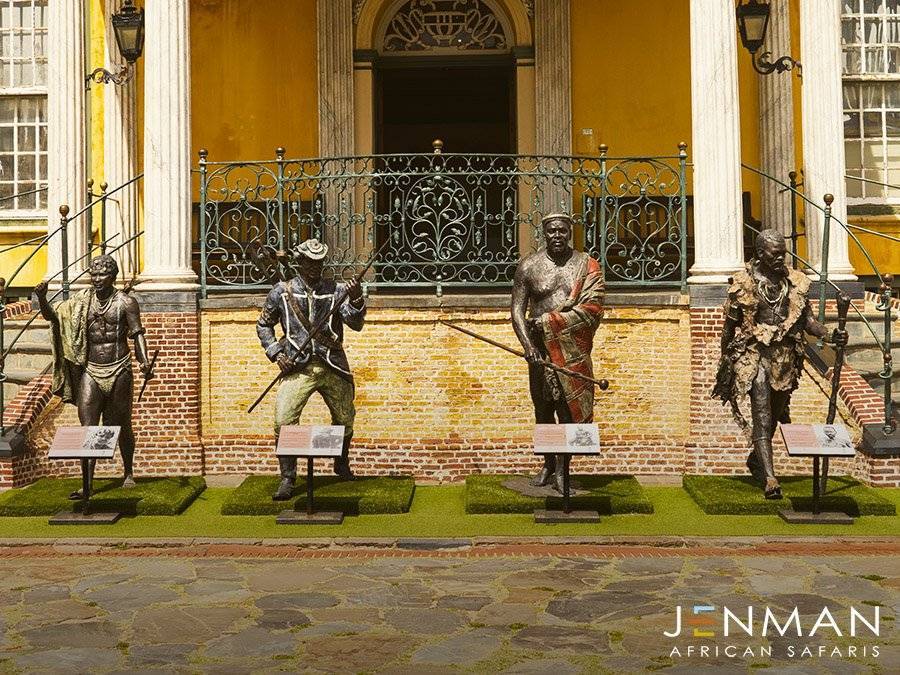
The De Kat Balcony, the elevated platform
from which colonial governors once proclaimed laws and read
out death sentences, now looks down on four bronze statues.
The installation is called the Kings of the Castle.
The four figures are:
Doman, the Khoekhoe leader who led the first armed resistance against the Dutch in the 1650s
King Cetshwayo of the Zulu
King Langalibalele of the Hlubi
King Sekhukhune of the Pedi.
Three of the four were imprisoned in the Castle. All four
resisted. All four lost their immediate battles. The
balcony from which they were once condemned now faces their
permanent, unbowed bronze gaze.
The colonial-era portraits of governors that once lined the
Castle’s interior walls have been taken down. In
their place are images of resistance and resilience. The
building has not been demolished, its difficult history
has not been papered over - but its meaning has been
deliberately and purposefully repositioned to one of
learning and educating as opposed to glorifying the past.
We need to learn from history. Embrace our past. Not erase
or whitewash it! How else will we be taught the lessons we
need to learn and not repeat the same mistakes. We need to
see the darker chapters in our history, shine a light on
it. Shining a light on past mistakes is not about blame.
It is about understanding.
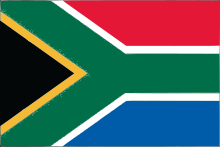
The democratic South African flag - flown from 1994 to today
Human Story: Krotoa’s Return (2016)
An acknowledgement, not a reversal
In 2016, a ceremony was held at the Castle to symbolically
bring Krotoa home - more than 340 years after she died on
Robben Island. Khoekhoe elders, historians, and community
leaders gathered in the courtyard whose colonial history
she had helped shape but from which she had been excluded.
A memorial was unveiled. It was not a reversal of history.
It was an acknowledgement of it.
The Final Word: What The Walls Remember
Outlasting the builders
The De Kat Balcony - where laws and death sentences were once proclaimedThe four bronze Kings of the Castle now face the balcony that once condemned them
The Dutch East India Company collapsed in
1799.
The British Empire is gone.
The apartheid government fell in 1994.
Three of the six powers that flew their flag over this
building have vanished from history entirely. A fourth, the
British Empire, exists now only in memory
and legacy. The only ones left are the
two versions of the South African state.
They are the ones who will decide what the Castle becomes
next.
Here is what the Castle proves: what gets built outlasts the
people who built it.
The workers who laid the first stone on 2 January 1666 could
not have imagined that their fortress would still be standing
three and a half centuries later, flying the flag of a
democratic republic they could never have dreamed of.
They built it to protect a spice trade. It ended up as
something far more complicated and far more interesting - a
monument to the full messiness of human history, including
the parts that are uncomfortable to look at.
When you walk through the Castle today, you are walking
through every version of it that has ever existed. The walls
do not pick a favourite era. They hold all of them at once.
What changes is who is doing the looking - and what they
are willing to see. It’s purely a matter of
perspective, what this Castle means to you.
For me… I like the idea of it holding the entirety of
its history between the Castle walls and on display for all
to see. I love the fact that all 6 flags fly outside the
Castle as if to say look at me, I am still here, through
good times and bad. I survived and I will continue to
thrive.